
- 2026 YTD 2–4 unit median
- $2.055M
- 2–4 unit closings
- 368
- The house-hacking approach
- Live in 1
San Francisco building sales through October 22
Same SFAR closed-sale sample
Rent the other legal apartments
Data: SFAR two- to four-unit building sales January 1–October 22, 2026. Public sources checked October 27, 2026. Calculator assumptions are illustrative.
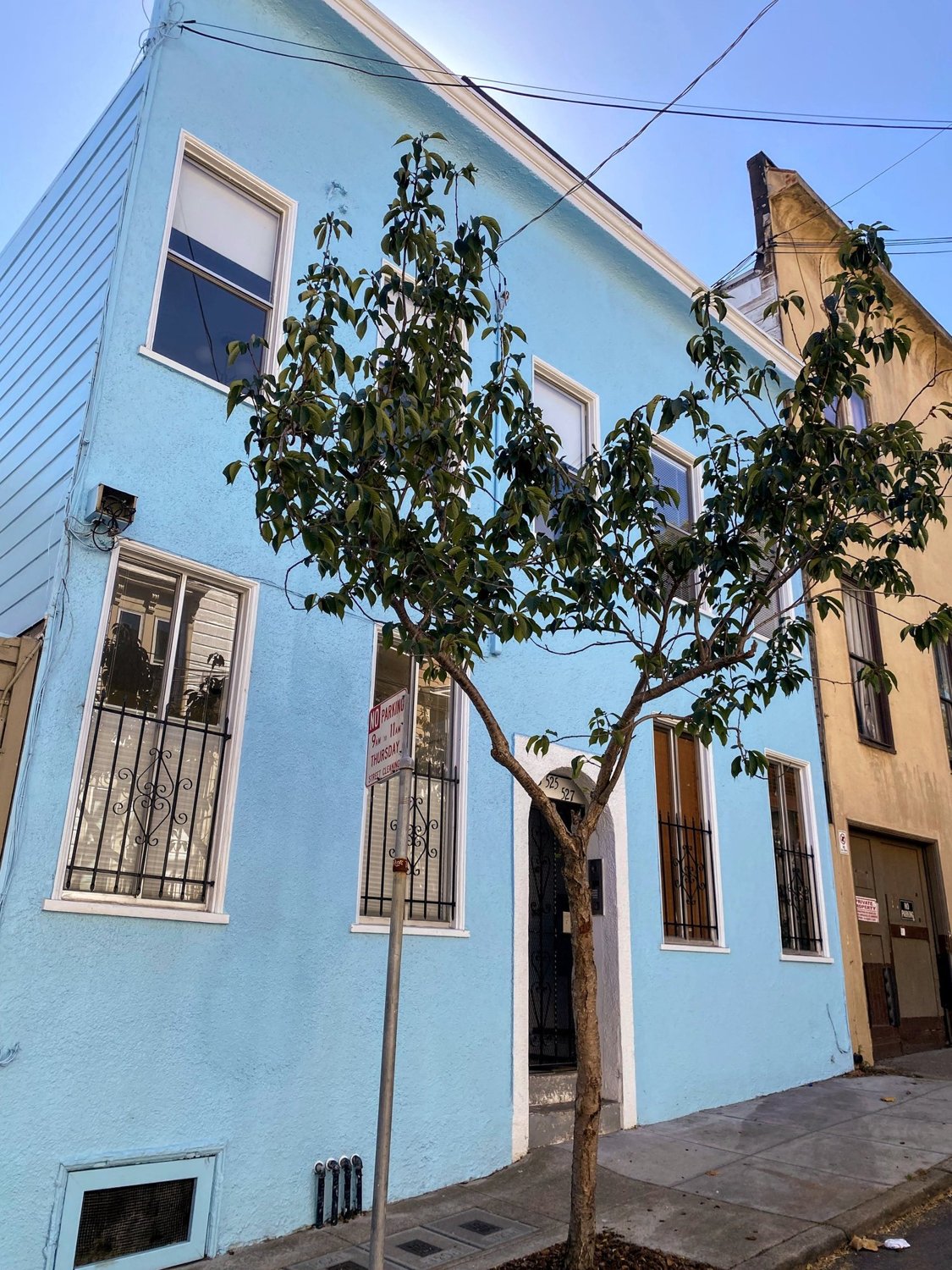
Caley Zheng and Lucas Beard used this approach at Linden Street in Hayes Valley. For us, it was an excellent investment: a home within a small apartment building, rental income from the other units, and opportunities to improve the property. The useful question for another buyer is how to find a building where the numbers and day-to-day ownership work together.
Linden Street: the strategy in practice
At 521–527 Linden Street, Caley and Lucas bought a four-unit building, lived in one apartment, and rented the others. The project included kitchen updates, dishwashers, in-unit laundry, replacement windows, and improvements to attic space. Those are tangible property decisions: improve the homes, make them more functional, and prepare them for rental use. [1]
| Decision | Why it matters |
|---|---|
| Buy a building with a home you want to occupy | The investment also has to work for your daily life |
| Use the other apartments as rentals | Income can offset part of the full building budget |
| Improve practical features and condition | Scope work around a realistic cost, permitted use, and rental plan |
| Take management seriously | Leasing, maintenance, tenant communication, and reserves are part of the investment |
Linden Street is our real-world example. The calculator below uses hypothetical inputs rather than the property’s purchase price, rents, or investment returns.
Step 1: Choose the right building and the right owner’s unit
Start with your housing needs and a two- to four-unit search. Which apartment would you live in? Does it have the light, layout, stairs, outdoor access, storage, and neighborhood setting you want? A building with compelling rental potential can still be the wrong home.
Then assess the rental apartments independently. Compare their actual size, condition, utility arrangements, legal use, and existing tenancies. Verify the legal unit count and building records; an extra room or unfinished space is not automatically another apartment. Five-plus-unit properties generally require a different financing discussion from the small owner-occupied buildings covered here.
Step 2: Build the financing and cash plan early
Tell your lender that you intend to occupy one unit and rent the others. Ask which owner-occupied multifamily programs fit the building, how rental income can be documented, what down payment and reserves are required, and which property conditions could block approval. Loan limits and underwriting depend on the program and unit count.
Fannie Mae’s September 2026 guidance allows eligible rental income from two- to four-unit principal residences, with documentation and qualification rules. For covered purchase scenarios, the calculation begins with 75% of gross monthly rent before subtracting the property’s principal, interest, taxes, insurance, and association dues, where applicable. Treatment also depends on factors including property-management experience and current housing-payment requirements. Have the lender calculate the usable income for your case. [2, 3]
Keep the down payment, closing costs, immediate repairs, initial leasing expenses, and cash reserves in separate lines. In the calculator’s starting $2 million example, 25% down is $500,000. An illustrative $40,000 for closing costs, $50,000 for initial work, and $75,000 of retained reserves would bring the cash allocated to $665,000. Those allowances are assumptions to replace with actual estimates, not financing requirements or Linden Street figures.
Step 3: Verify the rents and the occupancy plan
For occupied apartments, start with the leases, current lawful rents, deposits, payment history, included services, and outstanding issues. For vacant apartments, use genuinely comparable rentals and ask how much work and time are needed before leasing. A seller’s projected rent is a scenario until the condition, legal use, and market evidence support it.
Choose an owner’s unit you can lawfully occupy. A purchase does not, by itself, end an existing tenancy. If the plan depends on ending a tenancy or an owner move-in, get qualified San Francisco landlord-tenant advice before committing to the deal. The timeline and cost can change the investment. [4]
Many older San Francisco rentals have rent-increase and eviction protections. Owner occupancy does not create a blanket exemption. Confirm coverage for each unit and model lawful rent growth, rather than assuming you can reset every occupied apartment to an asking-rent estimate. [5]
Step 4: Underwrite your net housing cost
Use this sequence: rental income, less vacancy and collection allowance, less the full building operating budget and reserve contribution, then compare what remains with the mortgage payment. The result is your modeled monthly housing cost. It is more useful than subtracting gross rent from the loan payment.
How much of your housing cost could the rentals cover?
Live in one unit and rent the others. Adjust the assumptions below to estimate your share of the monthly cost. These are illustrative inputs, not Linden Street’s actual finances or a loan approval.
- Monthly mortgage P&I
- $9,481
- Collected rental income
- $9,263
- Your modeled monthly housing cost
- $4,332
30-year fully amortizing loan
3 rental units, after vacancy allowance
Includes the operating budget and capital reserve contribution
Monthly tax allowance: $2,000. Operating budget and reserves: $4,113, including $463 for management. Down payment: $500,000. Add closing costs, immediate work, and cash reserves separately.
Stress-test before you offer.
| Scenario | Monthly rent collected | Your net monthly cost |
|---|---|---|
| Your assumptions | $9,263 | $4,332 |
| Rents 20% lower | $7,410 | $6,092 |
| One rental unit unavailable all year | $6,175 | $7,265 |
One home is owner-occupied and produces no rent in this model. Vacancy applies to the remaining available rental units. Management is a share of collected rent; other expenses stay fixed in the stress cases. The model includes an editable reserve contribution and the full mortgage payment, but excludes income taxes, tax benefits, appreciation, selling costs, and the opportunity cost of your cash. Mortgage insurance, special assessments, and other property costs must be added to your estimates where applicable. It is a housing-cost model, not an investment return or lender-qualification calculation.
With the starting assumptions, a $2 million four-unit building has a $1.5 million loan. At an illustrative 6.50% fixed rate over 30 years, principal and interest are about $9,481 a month. Three rentals at $3,250 produce $9,750 scheduled rent, or $9,263 after a 5% vacancy allowance. After approximately $4,113 in operating costs and reserve contributions, the model leaves an owner housing cost of about $4,332 a month.
That is a housing-cost result, not a return on the down payment. Compare it with a home you would otherwise rent or buy, while considering the cash tied up, repair exposure, and management work. Principal repayment, changes in property value, and taxes affect the broader investment result but are not counted as cash rent in this model.
What the San Francisco small-building data tells us
San Francisco’s two- to four-unit building sample had 368 closings from January 1 through October 22, 2026, with a $2,055,000 median price and 16-day median time on market. The 2025 full-year sample had 407 sales, a $1.7 million median, and 28-day median marketing time. These are different groups of buildings and different-length periods. Source: Aggregated SFAR data, 2026.
Source: Aggregated SFAR data, 2026. 2026 YTD ends October 22. Cohorts mix two-, three-, and four-unit buildings with different occupancy and condition. These medians are not a same-building appreciation measure or a fourplex-only price estimate.
The practical implication is to arrive prepared. A median marketing period of 16 days can leave little time to start learning the financing and reviewing the leases. It does not tell you what a particular building should cost, whether the owner’s unit is available, or whether the rents support the price.
Step 5: Inspect the expensive shared components
Prioritize the roof, foundation, exterior, stairs, electrical service, plumbing, drainage, and other major building systems. Review inspections, permits, the residential building record, open violations, and insurance quotes. Translate known work into a scope, timing, and cash requirement before relying on projected rental income. [6]
Renovations can improve usability, as they did at Linden Street, but the budget needs more than a contractor’s headline number. Include design and permit needs, contingency, carrying costs, and any period when a rental apartment cannot produce income. Scope work around the lawful use and tenancy of each space.
Step 6: Make an offer that protects the actual plan
Bring the building, lease review, financing, insurance, inspection, and possession questions into the purchase strategy. Set a price ceiling from the current-income case and the required work. Treat future rent increases, added apartments, TIC sales, or condo conversion as separate possibilities rather than money already earned.
Before removing the relevant purchase conditions, know what the lender has accepted, how much cash is needed, which apartment you can occupy, and who carries any work or vacancy risk. Coordinate the deadlines with your agent, lender, inspectors, and attorney. [6]
Step 7: Prepare to operate a rental building
- Build a unit-by-unit rent roll and a process for rent collection, deposits, and records.
- Confirm the insurance, landlord registrations or reporting, and local requirements that apply to the property.
- Use lease documents and screening procedures appropriate to San Francisco and fair-housing requirements.
- Decide what you will manage yourself and what a property manager will handle. Include a management allowance even when testing a self-managed plan.
- Set a repair-response process, a capital reserve target, and a schedule for reviewing the budget.
- Keep the owner’s household spending separate from the rental operation.
Living in the building can make it easier to notice maintenance issues and understand the homes. It also puts you close to the operation. Good tenant communication, clear boundaries, and reliable systems matter as much as the purchase analysis.
Step 8: Track the investment beyond the first year
Review collected rent, vacancy, operating costs, reserve contributions, and major work against the plan. Keep tax treatment separate from cash performance. IRS guidance requires certain shared expenses to be allocated between personal and rental use when you live in part of a property. Work with your tax adviser on the appropriate allocation and reporting. [7]
If you later move out, rerun the analysis with all legal rental units, the costs of outside management, and any lender or insurance requirements. A building can change from an owner-occupied housing strategy to a rental investment, but that transition deserves its own model.
The stress tests we would run before buying
| Scenario | What to test |
|---|---|
| Rents are 20% below the initial plan | Can you still afford the monthly owner contribution? |
| One rental apartment is unavailable for a year | Can your cash cover the lower collections and any repair cost? |
| A roof or building-system replacement arrives early | Is the money available without relying on a refinance? |
| Insurance, taxes, or utilities cost more | Update each expense rather than applying a generic rent multiplier |
| You need professional management | Does the investment still work when your time has a cost? |
| The property value stays flat | Can the housing and income plan stand without appreciation? |
Stress cases are planning exercises, not forecasts. The calculator updates the first two cases from your inputs.
Our perspective: buy a home you like and a business you can run
House hacking at Linden Street worked well for Caley and Lucas because the approach brought a home and a small rental business into one purchase. For your next building, we would start with the apartment you want to live in, verify the income from the others, price the required work, and model the downside. The opportunity is strongest when the property fits your life and the investment works without stretching the assumptions.
Common questions
What is house hacking in San Francisco?
In this guide, it means buying a small multifamily building, living in one legal apartment, and renting the others to help cover ownership costs.
Can rent from the other units help me qualify for a mortgage?
Potentially. Eligible two- to four-unit owner-occupied properties can use documented rental income under applicable program rules. The lender determines the amount, documentation, and treatment for your situation. [2, 3]
Can I move into any unit after buying a tenant-occupied building?
Do not assume so. Existing tenancies and San Francisco occupancy rules must be reviewed before purchase. A sale alone does not end a tenancy. [4]
Will the other units pay my entire mortgage?
Sometimes the rent may cover a large share of the budget, but gross rent is not the amount available for debt service. Allow for vacancy, taxes, insurance, repairs, management, and reserves before judging the monthly cost.
Is the calculator based on Linden Street’s actual finances?
No. It uses editable hypothetical inputs. Linden Street illustrates the strategy; your acquisition needs its own rents, loan quote, expenses, repair budget, and occupancy plan.
What if I want a building with five or more units?
Discuss the financing and operating requirements separately with an appropriate lender. The calculator and buying framework here focus on two- to four-unit buildings with one owner-occupied home.
Methodology
Source: Aggregated SFAR data, 2026. The market comparison uses two- to four-unit San Francisco closed sales: full-year 2025 and January 1–October 22, 2026. Building medians mix unit counts, condition, location, and tenancy; they are not matched-building returns. The calculator treats one legal apartment as owner-occupied with no rental income. Scheduled rent is (total units minus one) × rent per rental unit. Collections subtract the vacancy allowance. Monthly operating costs include the purchase-price-based tax assumption, insurance, owner-paid utilities and other costs, maintenance, reserves, and management as a share of collected rent. Owner housing cost equals the full mortgage payment plus that budget minus collected rent. A negative result is a modeled surplus. Loan payments assume 360 equal payments at a constant illustrative rate; a zero rate uses principal divided by 360. Stress cases reduce rent by 20% or remove one rental unit for a full year, then apply the vacancy allowance to the remaining available units. The loan and fixed expense assumptions stay the same; management changes with collections. The model is separate from lender qualification and excludes tax benefits, appreciation, selling costs, and the opportunity cost of cash. Initial work and closing expenses need a separate budget. Linden Street illustrates Caley and Lucas’s ownership strategy; no numerical investment return is claimed for that property. Public guidance checked October 27, 2026.
Sources
- [1] Linden Street project story ↗
- [2] Fannie Mae: General rental income information ↗
- [3] Fannie Mae: Rental income from the subject property ↗
- [4] San Francisco Rent Ordinance: Evictions, including owner occupancy ↗
- [5] San Francisco Rent Board: Rental laws overview ↗
- [6] California DRE: Information for homebuyers ↗
- [7] IRS Publication 527: Residential rental property and personal-use allocations ↗