
- Adjusted Prop 19 allowance
- $1,044,586
- Principal-residence timing
- 1 year
- Illustrated $2M home: full reassessment
- $23,632/yr
Added to the parent’s factored base; qualifying transfers February 16, 2025–February 15, 2027
Qualifying occupancy and exemption claim for relief from transfer; separate exclusion claim required
FY 2026–27 rate; before exemptions and direct charges; hypothetical whole-home transfer
Data: Owner-supplied 2026 neighborhood house medians, exact cutoff unspecified. Prop 19 allowance: transfers February 16, 2025–February 15, 2027. SF tax rate: FY 2026–27. Public guidance checked October 26, 2026.
Inheriting a San Francisco house creates two decisions at once: what the home means to your family, and whether owning it fits your finances. A low property tax bill can change after a parent dies. Before choosing to move in, rent, or sell, establish the transfer date, the property’s taxable value, and who has authority to act.
The useful comparison is a written plan for all three paths. Estimate the new tax bill, major building work, any sibling payout, and the cash each option leaves available. A valuable house can still be an expensive asset to hold.
1. What Prop 19 changed for inherited homes
For transfers beginning February 16, 2021, the parent-child exclusion generally requires a qualifying family home that was the parent’s principal residence and becomes an eligible child’s principal residence. Keeping an inherited rental or second home does not satisfy that family-home requirement. [2]
The original $1 million allowance is indexed. For transfers from February 16, 2025 through February 15, 2027, the adjusted amount is $1,044,586. Use the amount applicable to the transfer date, rather than whichever amount is current when you file. [3]
For ordinary inheritances, the change-of-ownership date is generally the date of death, even if a deed or trust distribution comes later. A trust does not by itself prevent property tax reassessment. Special ownership interests can change the analysis, so have the assessor and estate attorney confirm the relevant transfer. [4]
2. SF math: what a new property tax bill can look like
San Francisco’s published secured property tax rate for fiscal year 2026–27 is 1.18162182%. The illustrations below multiply assessed value by that rate. They exclude direct charges, exemptions, annual inflation adjustments and partial-year supplemental billing; they are annualized planning comparisons, not tax bills. [5]
| Transfer-date market value | Qualifying taxable value | Annual tax: qualifying move-in | Annual tax: no exclusion |
|---|---|---|---|
| $1,025,000 | $250,000 | $2,954 | $12,112 |
| $2,000,000 | $955,414 | $11,289 | $23,632 |
| $3,500,000 | $2,455,414 | $29,014 | $41,357 |
| $8,250,000 | $7,205,414 | $85,141 | $97,484 |
Assumptions: whole-home transfer, parent’s factored base year value $250,000, adjusted allowance $1,044,586, all family-home conditions satisfied in the qualifying column. No other exclusion or special assessment program. Before homeowners’ exemption and direct charges. Figures rounded to the nearest dollar. [2, 3, 5]
Select an assessment scenario. Market-value labels are illustrative cases, not a time series. The table gives exact case inputs; all calculations use FY 2026–27’s rate before exemptions and direct charges. [2, 3, 5]
Take the $2 million illustration. The old $250,000 base produces about $2,954 in annual tax at the stated rate. A qualifying move-in produces a $955,414 taxable value and about $11,289 in tax. Without the exclusion, the annualized amount is about $23,632. Preserving some of the tax benefit does not mean inheriting the parent’s entire tax bill unchanged.
The $1.025 million example also matters: with a $250,000 old base, the no-increase ceiling is $1,294,586. An otherwise qualifying transfer at $1.025 million stays under that ceiling. A sale price above $1 million alone does not establish that Prop 19 will increase the taxable base.
The homeowners’ exemption is separate: an eligible owner-occupant can receive up to $7,000 off assessed value. It is not a $7,000 reduction in the tax bill. Our table leaves it out so the scenarios use a consistent pre-exemption basis. [6]
What the supplied neighborhood data adds
The supplied TurboHome chart shows 19 San Francisco neighborhood groups with at least 25 house sales in 2026. Every displayed median exceeds $1 million, from an exact $1,025,000 in Bayview to $8,250,000 in Pacific Heights. The extraction date and individual group counts were not supplied. These are sale-price medians, not inherited-home appraisals. [1]
[1] Select a group or open Data view. Shortened chart labels correspond to the full neighborhood names in the table below. Dollar values are converted from rounded chart medians, except the exact Bayview and Pacific Heights endpoints supplied in the brief. No claim that these medians are the assessor’s market values.
| Neighborhood | House median |
|---|---|
| Bayview | $1,025,000 |
| Visitacion Valley | About $1.10M |
| Excelsior | About $1.28M |
| Crocker Amazon | About $1.30M |
| Oceanview | About $1.41M |
| Outer Mission | About $1.56M |
| Bernal Heights | About $1.95M |
| Sunset District | About $1.96M |
| Lakeshore | About $2.19M |
| Glen Park | About $2.52M |
| Richmond District | About $2.61M |
| Inner Mission | About $2.65M |
| West of Twin Peaks | About $2.67M |
| Potrero Hill | About $2.80M |
| Noe Valley | About $3.50M |
| Eureka Valley | About $3.56M |
| Western Addition | About $4.09M |
| Marina | About $5.80M |
| Pacific Heights | $8,250,000 |
[1] At least 25 house sales per displayed group. Only the two endpoint dollar medians were supplied exactly; intermediate values are chart-rounded. Missing neighborhoods are not zero or necessarily cheaper. Exact cutoff and neighborhood boundaries were not provided.
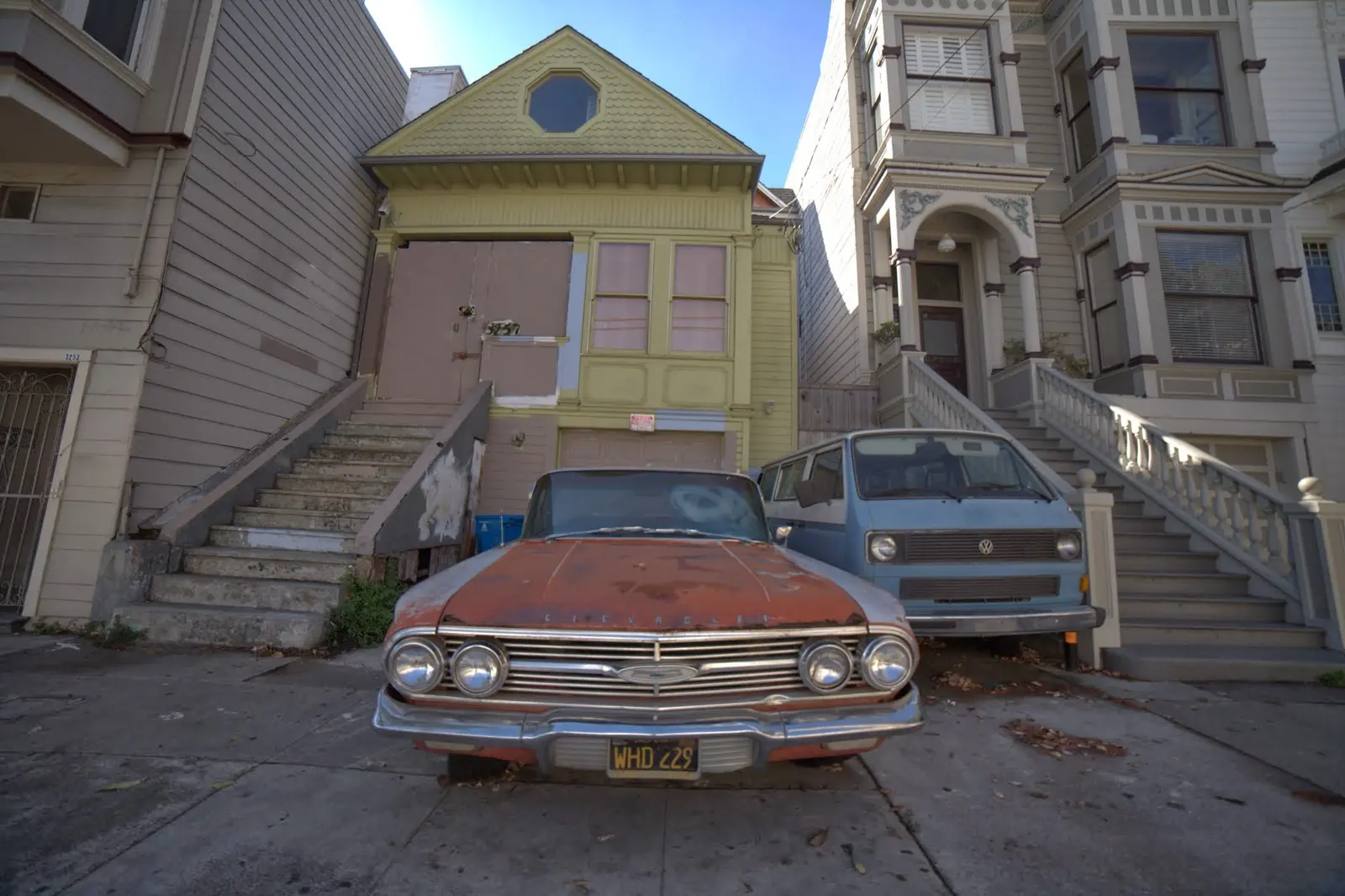
The accompanying brief says the typical house in most of these groups was built before 1950, but it supplies no age table. Treat that as a reason to inspect the building, not a quantified citywide finding. Budget for the actual roof, foundation, electrical service, plumbing and moisture conditions before assigning an inherited home a rental return or renovation premium. [1]
3. Move in, rent, or sell: compare the full plans
| Path | Can fit when | What to calculate first |
|---|---|---|
| Move in | The home fits your household and long-term plans | Qualifying tax estimate, repairs, sibling settlement, financing and the housing costs you replace |
| Rent | You want concentrated exposure to this property and can fund reserves | Post-reassessment cash flow, tenant rules, maintenance, major work, management and debt |
| Sell | You want liquidity, a simpler estate settlement or a different investment mix | Realistic proceeds after payoff, selling costs, tax reserves, prep and the time required |
Company decision framework. Tax eligibility and the right course depend on the actual ownership and estate documents.
Move in: San Francisco’s assessor guidance says at least one eligible inheriting child must make the home a principal residence within one year and file the homeowners’ exemption claim within that year. Occupancy has to be real; changing a mailing address is not a housing plan. Confirm what evidence and forms the assessor needs. [7]
Rent: if no eligible heir meets the principal-residence conditions and no other exclusion applies, underwrite the transferred interest at its reassessed value. Continuing the parent’s old bill in a rental spreadsheet can make a weak investment appear profitable. Temporary vacancy during administration is not a reason to skip eligibility review; establish whether timely qualifying occupancy is actually achievable.
| Annual line item | Assumption |
|---|---|
| Scheduled rent: $7,000 per month | $84,000 |
| Vacancy allowance: 5% of scheduled rent | −$4,200 |
| Routine maintenance budget: 10% of scheduled rent | −$8,400 |
| Management budget: 7% of scheduled rent | −$5,880 |
| Insurance budget | −$3,000 |
| Property tax before direct charges | −$23,632 |
| Operating cash before debt, income tax and major capital work | $38,888 |
Entirely hypothetical, not a local rent survey, insurance quote, management quote or recommendation. Percentage budgets use scheduled rent. Does not include utilities, leasing costs, direct assessments, major replacements or financing. Assess each separately. Unrounded property tax used in total.
That leaves about $38,888 a year, or 1.94% of the assumed $2 million property value, before debt, income tax and major capital work. A roof replacement or a sibling-buyout loan can materially reduce the cash available. This yield is an illustration, not a forecast or a reason by itself to sell.
Before renting, review the existing tenancy and the property-specific rules with a local attorney. SF’s Rent Board explains that exemptions from rent-increase limits and protection against eviction are different issues. Do not assume an inherited single-family house is exempt from all tenant protections, or promise vacant possession without checking. [8]
Sell: start with an as-is sale estimate and a second estimate after targeted preparation. Compare the expected additional net proceeds with the work’s cost, carrying period and execution risk. Selling may improve liquidity or simplify a family settlement even when keeping the home could preserve part of its tax base.
Property tax reassessment and capital gains use different bases
The assessor’s taxable value is not your income-tax basis. The IRS says inherited-property basis is generally fair market value at death, with exceptions including an elected alternate valuation. A low Prop 13 assessment does not mean you calculate taxable gain from what your parents paid decades ago. Obtain the appraisal and ask your CPA to confirm the basis and sale reporting. [10]
For example, if the confirmed inherited income-tax basis is $2 million and the home later sells for $2.1 million, the difference is $100,000 before selling expenses and other basis adjustments. It is not the $1.85 million difference between that sale price and the illustrative $250,000 property-tax base. This is a basis illustration, not an estimate of tax owed. [10]
Likewise, a principal-residence capital-gains exclusion has its own eligibility rules. Moving in for Prop 19 does not automatically qualify a later sale for the federal home-sale exclusion. Model the two tax systems separately. [11]
4. Siblings and buyouts: agree on value before changing title
If one heir wants the house and another wants cash, separate fair valuation, affordability and transfer structure. A $2 million debt-free home split equally implies $1 million of gross value per sibling before estate obligations and agreed adjustments. It does not establish the final buyout price or show that the remaining owner can obtain financing.
- Agree on an independent valuation date and a method for resolving a second appraisal.
- List estate debts, taxes, repair obligations and carrying costs before allocating proceeds.
- Have a lender test the keeping heir’s purchase or refinance plan, reserves and post-transfer property taxes.
- Put occupancy, interim expenses, payout timing and a fallback sale process in writing with counsel.
A later transfer from one sibling to another is not itself a parent-child transfer. The BOE also distinguishes a properly authorized non-pro-rata estate distribution from a sibling exchange after distribution. Review the will or trust, each beneficiary’s entitlement, other estate assets and any proposed borrowing before recording deeds. No buyout structure automatically preserves the full tax base. [9]
Our practical preference is to resolve the keep-versus-sell decision before expensive preparation. If one heir may buy the home, the family should know whether that heir can fund the payout and carry the property. If the plan fails underwriting, set a clear route to a market sale rather than leaving the house and family finances in limbo.
5. Selling an inherited SF home: probate, trusts and preparation
First confirm the seller’s authority with the estate attorney and title company. Probate is not one universal sale process. California court guidance distinguishes full from limited authority under the Independent Administration of Estates Act. Full authority can permit a real-property sale without court confirmation, subject to required procedures and objections; limited authority generally requires court supervision for that sale. [12]
For a trust-held house, have counsel and title confirm that it is actually held in the trust, who is authorized to sign, and which approvals or notices apply. Do not promise a closing date based only on the words “trust sale.” Separate the property’s expected marketing period from the estate’s legal and administrative timeline.
- Secure and insure the property; tell the insurer how occupancy has changed and confirm vacancy coverage.
- Locate title records, mortgage and tax statements, the estate documents, existing leases, permits and available repair history.
- Preserve family documents and agree on an inventory before cleanout, donation or disposal.
- Commission inspections and prioritize hazards, leaks and defects that affect a buyer’s financing or confidence.
- Price cleanout, modest presentation work and larger projects separately. Test each against likely additional net proceeds.
- Prepare disclosures with the agent and counsel; do not assume inherited means no disclosure obligations.
- Use a net sheet that includes payoff, agreed selling costs, transfer taxes, carrying expenses, work and reserves for unsettled estate obligations.
A hypothetical $40,000 preparation plan expected to add $75,000 to sale proceeds leaves a $35,000 cushion before extra selling costs, delay and uncertainty. If another four months costs $4,000 per month to carry, that cushion falls to $19,000. These assumptions are not a promised renovation return; obtain bids and comparable evidence before committing estate money.
6. Deadlines and filings heirs miss
| Action | Timing to confirm | Why it matters |
|---|---|---|
| Report the death-related ownership change | Generally within 150 days; probate estates have an inventory-and-appraisal filing rule | BOE-502-D is distinct from the exclusion application. [13] |
| Establish qualifying principal residence and file its exemption claim | Within one year of transfer for relief from transfer | Do not wait for estate distribution to ask about eligibility. [7] |
| File the parent-child exclusion claim, BOE-19-P | Generally within three years or before a third-party transfer, whichever comes first | Separate from homeowners’ exemption; special supplemental/escape notice timing may apply. [2, 14] |
| Review assessor notices immediately | Calendar the actual mailing date and response periods | A qualifying six-month notice-based filing window may preserve timely exclusion; late relief can be prospective. [14] |
| Reserve for taxes while the estate is administered or sold | From the transfer and again at closing | Supplemental assessments can reflect a higher value for part of a fiscal year. [5] |
This is a planning checklist, not a substitute for advice on the actual transfer, notice or appeal. Missing an exclusion deadline and missing an assessment-appeal deadline are different issues.
Use SF’s current BOE-19-P form and the assessor’s filing portal or other accepted submission method. Keep a complete copy and delivery confirmation. The homeowners’ exemption claim, death statement and parent-child claim serve different purposes; submitting one does not automatically complete the others. [6, 13, 14, 15]
If a deadline has already passed, ask the assessor promptly about the specific notice and available relief. The BOE’s fact sheet describes a six-month supplemental-or-escape-notice route for an exclusion claim and prospective relief for certain late claims. These provisions do not make late occupancy harmless or guarantee a refund. [2]
Common questions
Does inheriting a house in San Francisco automatically preserve the old property tax bill?
No. The family-home exclusion has occupancy, value and filing requirements. Even a qualifying transfer can increase the taxable base when transfer-date market value exceeds the parent’s factored base plus the applicable adjusted allowance.
Is the Prop 19 limit still exactly $1 million?
The original allowance is indexed. It is $1,044,586 for transfers February 16, 2025 through February 15, 2027, added to the parent’s factored base year value for the value-limit test. [3]
Can I keep the exclusion if I rent out the whole inherited house?
A whole-home rental that does not serve as an eligible heir’s principal residence generally will not meet the family-home requirements. Confirm occupancy timing and any other applicable exclusion with the assessor. Existing tenants require separate legal review.
Can only one sibling move in?
SF’s guidance allows at least one eligible inheriting child to establish the required principal residence. A later sibling buyout needs its own analysis and can cause reassessment of the transferred interest. [7, 9]
Should I sell my inherited house in California immediately?
There is no universal deadline or best outcome for every family. Confirm legal authority, tax dates and the building’s costs, then compare achievable net sale proceeds with the move-in and rental plans.
Methodology
[1] is the TurboHome chart and narrative supplied by Lucas Beard, transcribed in https://sanfranciscorealestatecompany.com/data/inherited-house-2026-10-26.json. It covers 19 neighborhood groups with at least 25 house sales in 2026; extraction cutoff, subgroup counts and boundaries are unspecified. Bayview and Pacific Heights medians are exact as supplied; other values are rounded chart readings. No transaction or building-age export was provided, and no press estimate of 25% appreciation is substituted for these data. Tax illustrations assume an otherwise qualifying whole-home inheritance, a $250,000 factored base, and an appreciating property without another exclusion or restricted-value program. Qualifying taxable value = max($250,000, transfer-date market value − $1,044,586); no-exclusion value = transfer-date market value. Annualized tax = modeled value × 0.0118162182 before the homeowners’ exemption, direct charges, annual factoring and supplemental proration. Rental budgets and sale-preparation figures are company-created assumptions, not market observations or quotes. Rental operating cash uses unrounded tax, then rounds the final result; it excludes debt, income tax and major capital work. The 1.94% illustration divides that cash by the assumed $2 million asset value and does not measure return on inherited cash equity. Sources checked October 26, 2026; some official pages were available through indexed excerpts while direct access was restricted.
Sources
- [1] Owner-supplied TurboHome neighborhood medians and reproducible tax illustrations, prepared October 26, 2026 ↗
- [2] BOE · Proposition 19 Fact Sheet, Publication 801 (June 2025), value test and filing rules ↗
- [3] BOE · March 7, 2025 indexed exclusion announcement, effective February 16, 2025–February 15, 2027 ↗
- [4] BOE · Letter to Assessors 2024/052, reporting requirements when a real property owner dies ↗
- [5] SF Treasurer & Tax Collector · Secured Property Taxes, FY 2026–27 rate and supplemental assessments ↗
- [6] SF Assessor-Recorder · File for the homeowners’ exemption ↗
- [7] SF Assessor-Recorder · A guide to property matters following an owner’s death ↗
- [8] SF Rent Board · Partial exemption for certain single-family homes and condominiums ↗
- [9] BOE · August 3, 2026 FAQ, questions 8–10, 39–42 and 53: occupancy, trusts, distributions and removal ↗
- [10] IRS · Gifts & inheritances: basis and selling inherited property ↗
- [11] IRS · Publication 523, Selling Your Home, separate home-sale exclusion requirements ↗
- [12] California Superior Court, Alameda County · Administering the Estate, independent administration and real-property sale authority ↗
- [13] SF Assessor-Recorder · Change in Ownership Statement, Death of Real Property Owner, BOE-502-D ↗
- [14] SF Assessor-Recorder · BOE-19-P parent-child reassessment exclusion claim ↗
- [15] SF Assessor-Recorder · Community portal for exemptions, exclusions and assessment information ↗
- Related reading · How to price a San Francisco house ↗
- Related reading · Evaluating a San Francisco investment property ↗
- Related reading · Reading San Francisco buildings ↗
- Neighborhood context · NoPa market report, with Panhandle data-proxy disclosure ↗