
- 2026 YTD TIC sales
- 238
- Median TIC sale price
- $1.25M
- Median time on market
- 17 days
San Francisco MLS closings through October 27
Same citywide closed-sale sample
A market statistic, not a closing timeline
Data: SFAR MLS closed sales January 1–October 27, 2026, extracted October 27. Public sources checked October 27.
What do you actually own when you buy a TIC?
Imagine a two-flat building with two owners, each holding a 50% interest. Each owns half of the whole property rather than legal title to one physical floor. Their agreement assigns the upper flat to one owner and the lower flat to the other. It also identifies shared areas and any exclusive-use yard, storage, or parking. This is an illustrative structure; real ownership percentages and expense allocations can differ. [1]
| Document | What it establishes | What to check |
|---|---|---|
| Recorded deed | Your undivided ownership percentage | The buyers, vesting, property description, and percentage being transferred |
| TIC agreement and amendments | Occupancy, use, governance, expenses, and transfer rules | Your assigned home and spaces, decision rules, remedies, and cost allocations |
| Loan and security documents | The debt and the interest securing it | Individual versus group financing, existing liens, and required releases |
Ownership, occupancy, and financing need to align. A marketing floor plan does not replace the legal documents. [2]
The word “tenant” can be confusing. Here it describes a form of ownership, not a rental lease. This article concerns residential TICs with assigned occupancy rights, rather than vacation timeshares or passive investment syndications. [6]
TIC versus condo: the practical difference
| Question | Residential TIC | Condominium |
|---|---|---|
| What do you own? | An undivided share of the property | A legally defined condominium interest plus common-area rights |
| Where do your home’s boundaries or rights come from? | The agreement assigns exclusive occupancy and use | Recorded subdivision documents define the unit |
| How does building management work? | The agreement sets the group’s rules and responsibilities | The HOA’s governing documents set the rules |
| How do you borrow? | A fractional TIC loan or, in some groups, shared financing | A condominium mortgage subject to borrower and project approval |
| Does it become a condo automatically? | No; condominium conversion is a separate process | Condominium status is already established |
The ownership structure differs even when two homes look similar. Review the actual documents, financing, and building condition. [2, 3]
For a buyer, the important distinction is the package of rights and obligations. A desirable floor plan cannot resolve unclear storage rights, an underfunded roof reserve, or an agreement that does not fit the proposed financing. Those questions belong in the purchase analysis.
What the San Francisco TIC market data says
Aggregated SFAR MLS data show 238 San Francisco TIC closings from January 1 through October 27, 2026. The median sale price was $1,250,000, median price per square foot was $1,083, and 66.4% sold above the reported list price. The median time on market was 17 days. These figures describe completed sales, not all available TICs.
| Metric | TICs | Condos |
|---|---|---|
| Median sale price | $1,250,000 | $1,275,000 |
| Median price per square foot | $1,083 | $1,124 |
| Median days on market | 17 | 15 |
| Sold above reported list price | 66.4% | 59.0% |
January 1–October 27, 2026. Source: Aggregated SFAR data, 2026. Sample medians do not control for property characteristics.
The TIC median sale price was $25,000, or about 2.0%, below the condo median in this sample. The price-per-square-foot gap was about 3.6%. That is a reason to compare closely, not to assume every TIC is a bargain. A higher borrowing cost, different down payment, or upcoming building work could outweigh a lower purchase price. The data do not establish that easier financing caused the gap to narrow.
A small market. A distinct set of tradeoffs.
1,899 TIC sales since 2020. Explore where they trade, how the market has moved, and why a single citywide discount can hide important differences. Data pulled October 27, 2026.
The raw pricing gap has narrowed.
The annual median price-per-square-foot gap versus condos was 11.6% in 2021 and 3.6% in 2026 YTD, a change of 8.0 percentage points. These are different sales samples, not a same-home appreciation index or proof that financing caused the change.
Full calendar years 2020–2025; 2026 YTD through October 27. Source-reported gaps are rounded. Filtered square-footage samples, not matched properties.
Denominator includes condos, houses, TICs, co-ops, and townhouses. Annual shares range from 5.3% to 6.7%; 2026 YTD is 6.3%. Property type follows MLS coding.
*2026 Q4 is partial through October 27, with only 25 closings; its 13-day median and 84% above-asking share are provisional sample results. Full 2026 Q3: 65 closings, 17-day median, 63.1% above asking.
Concentration is different from local market share.
The five largest groups account for 1,016 of 1,899 TIC closings, or 53.5%: Inner Mission, Western Addition, Haight-Ashbury, Eureka Valley, and the Richmond District. Inner Mission alone accounts for 17.2% of citywide TIC sales, while TICs represent 17.7% of all residential sales within Inner Mission. Those are different denominators.
Darker cells mean a higher value within that column. Color does not rate investment quality. Gray means unavailable or flagged as a small sample.
Swipe or scroll horizontally to compare all columns →
| Neighborhood | TIC closings¹ | TIC share of local sales¹ | Last 12 months² | Median TIC price³ | Raw $/sq ft gap³ |
|---|---|---|---|---|---|
| Inner Mission88 TIC sales with usable sq ft³ | 327 | 17.7% | 38 | $899,000 | 8.3% |
| Western Addition66 TIC sales with usable sq ft³ | 193 | 9.2% | 35 | $1,200,000 | 6.6% |
| Haight-Ashbury51 TIC sales with usable sq ft³ | 168 | 16.9% | 22 | $1,484,000 | 18.1% |
| Eureka Valley56 TIC sales with usable sq ft³ | 164 | 10.7% | 31 | $1,117,000 | 13.9% |
| The Richmond District54 TIC sales with usable sq ft³ | 164 | 8.7% | 23 | $1,045,000 | 10.3% |
| Russian Hill40 TIC sales with usable sq ft³ | 129 | 14.9% | 20 | $1,075,000 | 19.4% |
| Nob Hill54 TIC sales with usable sq ft³ | 116 | 13.3% | 31 | $1,153,000 | 6.6% |
| Noe Valley36 TIC sales with usable sq ft³ | 116 | 9.8% | 23 | $1,075,000 | 9.4% |
| The Marina15 TIC sales with usable sq ft³ | 91 | 8.7% | 17 | $1,300,000 | 16.0% |
| Sunset District20 TIC sales with usable sq ft³ | 86 | 3.0% | 5 | $772,000 | 2.5% |
| Bernal Heights22 TIC sales with usable sq ft³ | 81 | 6.2% | 11 | $855,000 | 9.8% |
| North BeachSmall sample13 TIC sales with usable sq ft³ | 74 | 14.4% | 15 | $908,000 | Not available |
| Pacific Heights19 TIC sales with usable sq ft³ | 53 | 4.3% | 5 | $1,450,000 | 12.1% |
| Potrero HillSmall sample12 TIC sales with usable sq ft³ | 42 | 3.8% | 7 | $1,180,000 | Not available |
| Presidio HeightsSmall sample3 TIC sales with usable sq ft³ | 23 | 6.0% | 4 | $1,918,000 | Not available |
| Twin PeaksSmall sample7 TIC sales with usable sq ft³ | 19 | 5.3% | 7 | $820,000 | Not available |
| Downtown / Civic CenterSmall sample3 TIC sales with usable sq ft³ | 18 | 2.7% | 4 | $587,000 | Not available |
| South of MarketSmall sample5 TIC sales with usable sq ft³ | 13 | 0.4% | 0 | $705,000 | Not available |
| Glen ParkSmall sample1 TIC sales with usable sq ft³ | 10 | 2.3% | 1 | $879,000 | Not available |
| West of Twin PeaksSmall sample2 TIC sales with usable sq ft³ | 4 | 0.3% | 2 | Not available | Not available |
| Outer MissionSmall sample1 TIC sales with usable sq ft³ | 4 | 0.5% | 0 | Not available | Not available |
| ExcelsiorSmall sample0 TIC sales with usable sq ft³ | 2 | 0.2% | 0 | Not available | Not available |
| Visitacion ValleySmall sample0 TIC sales with usable sq ft³ | 2 | 0.5% | 0 | Not available | Not available |
¹ January 2020–October 27, 2026. Share divides TIC sales by all residential sales in that area, not by all city TIC sales. ² Source field: last 12 months as of October 27. ³ January 2024–October 27, 2026. Neighborhood gaps require at least 15 usable TIC sq ft observations. Broad provider areas are not interchangeable with neighborhood-guide boundaries.
ZIP 94133 has the highest TIC share among the listed ZIPs.
In 94133, 19.1% of recorded residential sales were TICs over 2020–2026 YTD. ZIP 94110 has the largest TIC count, at 378 sales. A ZIP is a postal area, not a substitute for a property’s neighborhood or comparable-sale search.
Darker cells mean a higher value within that column. Color does not rate investment quality. Gray means unavailable or flagged as a small sample.
Swipe or scroll horizontally to compare all columns →
| ZIP code | TIC closings¹ | TIC share of local sales¹ | Last 12 months² | Median TIC price³ | Median TIC $/sq ft³ |
|---|---|---|---|---|---|
| 94110 | 378 | 13.4% | 47 | $920,000 | $910 |
| 94117 | 239 | 15.2% | 37 | $1,380,000 | $1,015 |
| 94114 | 216 | 10.2% | 42 | $1,138,000 | $1,053 |
| 94109 | 200 | 8.5% | 45 | $976,000 | $930 |
| 94133 | 128 | 19.1% | 25 | $1,008,000 | $1,049 |
| 94115 | 127 | 8.2% | 15 | $1,140,000 | $989 |
| 94118 | 123 | 10.3% | 19 | $1,200,000 | $921 |
| 94123 | 89 | 7.5% | 16 | $1,420,000 | $1,088 |
| 94103 | 76 | 6.7% | 7 | $835,000 | $812 |
| 94131 | 71 | 3.8% | 15 | $879,000 | $968 |
| 94122 | 68 | 4.7% | 3 | $749,000 | $948 |
| 94121 | 64 | 5.6% | 9 | $1,049,000 | $984 |
| 94102 | 43 | 5.9% | 6 | $1,258,000 | $832 |
| 94107 | 42 | 1.8% | 7 | $1,180,000 | $928 |
| 94108Small sample | 14 | 5.0% | 3 | $3,223,000 | $1,414 |
| 94112Small sample | 7 | 0.4% | 0 | Not available | Not available |
| 94116Small sample | 7 | 0.5% | 3 | $1,995,000 | $1,422 |
¹ January 2020–October 27, 2026. Share divides TIC sales by all residential sales in that area, not by all city TIC sales. ² Source field: last 12 months as of October 27. ³ January 2024–October 27, 2026. Neighborhood gaps require at least 15 usable TIC sq ft observations. Broad provider areas are not interchangeable with neighborhood-guide boundaries.
Bedroom count changes the comparison.
The two-bedroom median is $990,000 for TICs versus $1,287,000 for condos, a $297,000 raw difference. But the price-per-square-foot gap is only 7.9%, versus a 23.1% price gap. Size and property mix may explain part of the difference; bedroom matching alone does not control for location, parking, building age, or condition.
Pooled January 2024–October 27, 2026. Studios have only 11 TIC sales. Select a series to compare; these are unmatched groups.
| Bedrooms | TIC / condo sales | Raw price gap | Raw $/sq ft gap |
|---|---|---|---|
| 0 (studio) | 11 / 209 | -3.4% | Not available |
| 1 | 149 / 1,666 | 2.6% | -3% |
| 2 | 287 / 2,576 | 23.1% | 7.9% |
| 3 | 238 / 1,126 | 18.5% | 10.6% |
| 4+ | 64 / 181 | 26.7% | 21.7% |
Positive gaps mean a lower TIC median; negative values mean a higher TIC median. One-bedroom TICs are 2.6% lower in median price but 3.0% higher per sq ft. The studio sq ft gap is suppressed in the source and stays blank here.
A modest shift toward the lower price bands.
The first two source bands, below $1 million as labeled, contain 342 of 749 TIC sales (45.7%) versus 2,343 of 5,758 condo sales (40.7%). Yet condos have the larger under-$750,000 share: 22.4% versus 19.5%. TICs are not uniformly the lowest-priced option.
January 2024–October 27, 2026: 749 TIC and 5,758 condo closings. Each percentage uses its own ownership-type total, not the two groups combined. Source bands are reproduced as provided; rounded shares may not total 100%.
Data windows and sample limits
2026 is year to date through October 27; 2026 Q4 is partial with 25 TIC sales. Neighborhood and ZIP counts and market shares cover 2020–2026 YTD; price and days-on-market comparisons pool 2024–2026 YTD. Square-footage screen: 300–6,000 sq ft and $250–$4,000 per sq ft. About 25% of TIC sales have no usable square footage; price-per-square-foot sample sizes are smaller. Raw discount = 1 − TIC median price per sq ft / condo median price per sq ft. No adjustment for building age, size, condition, parking, or dues. Neighborhood discount is suppressed with fewer than 15 usable TIC square-footage observations. Source low-sample flags and blank values are preserved. Sale-to-list is an average in this export, not a median; the README does not specify original versus final asking price. Neighborhood mapping is provider-defined and broader than some local guide boundaries. Listing-agent property-type coding can miss TICs. Rows are aggregates; do not average group medians or reconstruct transaction-level distributions.
Neighborhood and ZIP heatmaps compare columns on separate scales. A dark price cell is expensive, not necessarily a better opportunity. Sales concentration is historical transaction activity, not a count of homes currently available.
Source: Aggregated SFAR data, 2026.
How TIC loans work, and why the structure matters
An individual fractional TIC loan is secured by the borrower’s undivided interest. A group or blanket loan involves shared property debt. Separate loans make the mortgage obligations more distinct, but owners still share the building and its operating responsibilities. Identify existing liens and the lender’s release requirements before treating a sale as independent.
Redwood Credit Union offers a dedicated TIC loan program. Its public page, checked October 27, 2026, states a 20% down-payment requirement and loan amounts up to $2 million. Those are published program parameters, not an approval for a particular buyer or building. Ask for the actual rate, adjustment terms, fees, insurance requirements, and closing conditions. [3]
Birch Street: putting the ownership structure to work
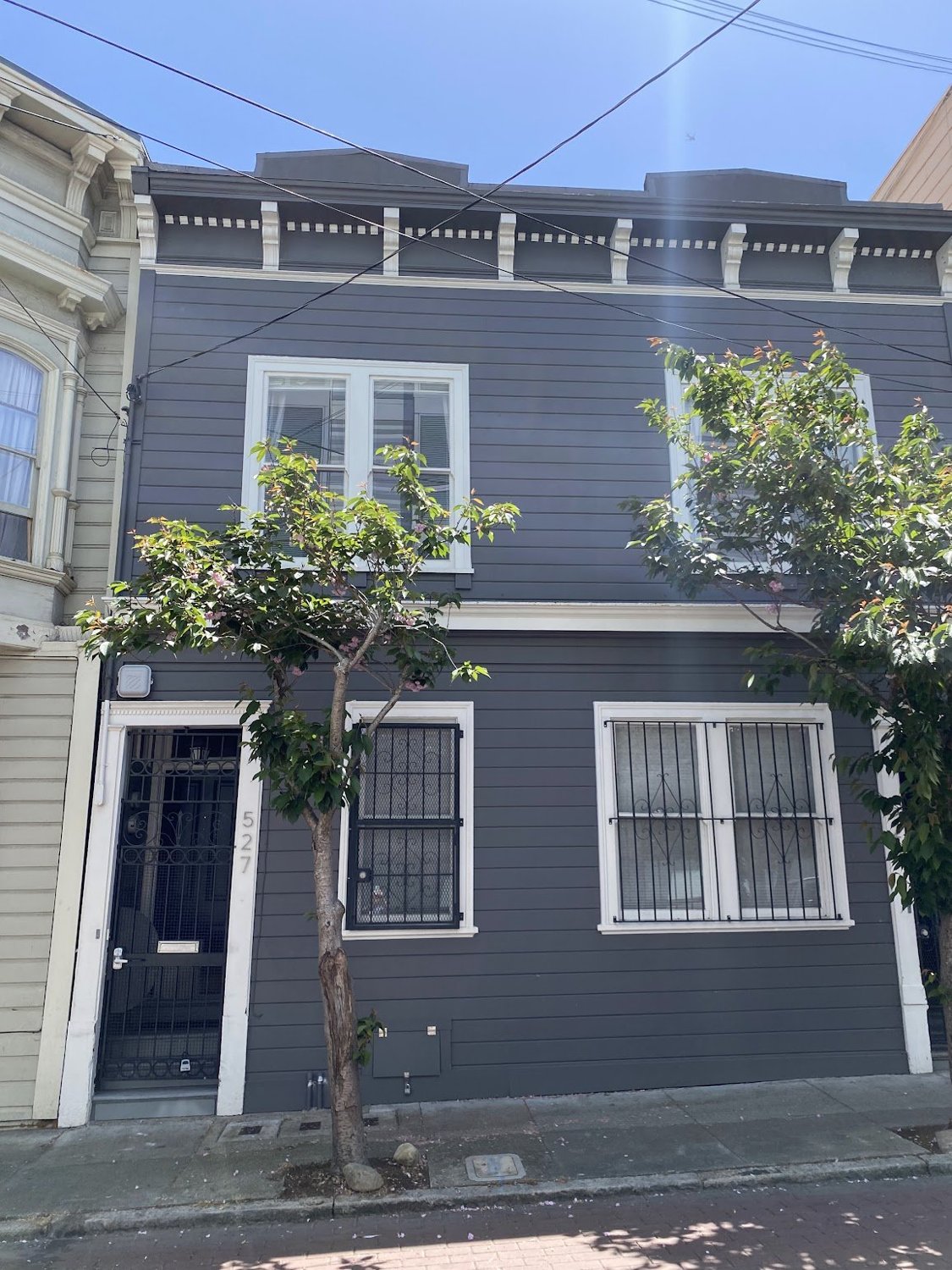
At 527–529 Birch Street, selling one TIC interest and refinancing the retained interest required a coordinated closing with Redwood Credit Union. The sale, refinance, and escrow timeline needed to work together. For buyers and sellers, the takeaway is practical: establish the financing sequence and any linked closing requirements before committing to a date.
The Birch Street financing also required an itemized building budget showing each co-owner’s share of the dues. Reserves, insurance, repairs, garbage, water, and property taxes needed clear allocations. Some expenses were shared equally; others followed a different calculation. A 50% title share does not, by itself, answer how every line of the budget is paid.
A successful TIC purchase also needs precise occupancy and use rights. Identify the assigned home, parking, storage, and outdoor areas separately from the ownership percentage, then review the agreement, financial disclosures, and management records together. A two-flat building can feel straightforward while still needing careful coordination.

What goes into TIC dues and shared expenses?
Start with a line-by-line budget: building insurance, shared utilities, garbage, routine repairs, administration, and reserves for larger work. Then identify what you pay separately, such as your mortgage, individual insurance, and any tax contribution collected outside the regular dues. Ask what is included, how it is allocated, who collects it, and whether the bank balance matches the records.
Property taxes require their own allocation. California’s general rule treats a transfer of a TIC interest as a change in ownership of the interest transferred, subject to applicable exclusions. Do not automatically apply one owner’s historical tax bill to the incoming buyer. Have escrow and your tax adviser reconcile the expected assessment, supplemental bills, and the agreement’s payment method. [5]
Does forming a TIC mean converting the building to condos?
No. Organizing TIC ownership and creating separately subdivided condominiums are different processes. Future condominium conversion should be evaluated separately from the TIC purchase. Verify the building’s legal units, ownership and occupancy history, tenant history, and current city requirements before assigning value to a future conversion. [6]
For a project with five or more legal units, California DRE guidelines generally require a public report for initial marketing or sale of occupancy-based TIC interests; exemptions and resales need separate review. A DRE public report does not turn the interests into condominiums. Smaller projects also need a sound agreement and transaction structure. Our conversion guide covers these paths in more detail. [2]
The questions we would answer before buying
- What percentage will I own, and which exact home, storage, parking, or outdoor areas can I use?
- Do the signed agreement, amendments, addendum, title report, and proposed loan tell the same story?
- How are taxes, insurance, utilities, repairs, reserves, and unexpected assessments divided?
- What happens when owners disagree, someone misses a payment, or a major repair cannot wait?
- What restrictions or approvals apply to resale, refinancing, rental use, or alterations?
- Are there tenants, occupancy issues, building-record discrepancies, or unresolved work to investigate?
- Does the purchase work financially if the property remains a TIC throughout my ownership?
San Francisco’s Rent Board expressly holds TIC co-owners jointly responsible for the annual Rent Board fee assessed to the property, regardless of their ownership share. That narrow example illustrates why separate ownership percentages do not make every building obligation separate. Any proposed change in an existing tenant’s occupancy needs its own review. [4]
Our perspective: buy the home and understand the agreement
A TIC can be a compelling way to buy the San Francisco home you want. We focus on whether the property, financing, shared budget, and co-ownership rules make sense together. Compare the full cost with nearby condos, test a realistic repair reserve, and make the purchase work without assuming a future condo conversion. The right analysis is specific to the building and the buyer.
Common questions
Is a TIC the same as renting?
No. A TIC buyer acquires an ownership interest in real estate. In the residential structure discussed here, the agreement assigns the right to occupy a particular home. [6]
Do I own my apartment if I buy a TIC?
You own an undivided share of the property, with contractual rights to occupy the assigned home. You do not own a separately subdivided condominium unit. [2, 6]
Can I get my own mortgage on a TIC?
Individual fractional TIC financing is available from specialist lenders, including Redwood Credit Union. Approval depends on the borrower, property, agreement, and proposed loan. [3]
Are TICs always cheaper than condos?
No. The 2026 YTD SFAR MLS sample has a lower TIC median, but the two groups contain different properties. Compare similar homes and total ownership costs rather than applying a universal discount.
Can a TIC be sold separately?
A TIC interest can be sold, but the agreement, financing, existing liens, and any applicable approvals or state requirements shape the process. Check those before setting the sale timeline.
Does a TIC automatically become a condo?
No. Condominium conversion is separate and property-specific. Buy with a plan that also works if the home remains a TIC. [6]
Methodology
Source: Aggregated SFAR data, 2026. Data extracted October 27, 2026. Annual and quarterly history starts in 2020; 2026 is YTD through October 27. Quarter 4 is partial with 25 closings. Neighborhood and ZIP concentration counts cover 2020–2026 YTD; their price and days-on-market metrics and the bedroom and price-band comparisons pool January 2024–October 27, 2026. All 1,899 annual sales reconcile to the quarterly and neighborhood counts. The 2024–2026 YTD TIC count is 749 in both the annual totals and the bedroom and price-band files; the latter two also reconcile to 5,758 condo sales. Underlying transaction records are not included. TICs and condos are unmatched samples. The citywide price gap is ($1,275,000 minus $1,250,000) divided by $1,275,000, or 1.96%; the per-sq-ft gap is ($1,124 minus $1,083) divided by $1,124, or 3.65%. Source-reported percentages are displayed as provided. Square-footage data screen for 300–6,000 sq ft and $250–$4,000 per sq ft; about 25% of TIC sales have no usable square footage. Missing and suppressed values stay unavailable. Neighborhood gaps need at least 15 usable TIC observations. The export labels sale-to-list as an average and does not specify original versus final asking price. MLS coding and broad provider geographies affect coverage. Do not average medians, annualize the partial quarter, or attribute pricing changes to financing without separate evidence. The reserve illustration assumes a $30,000 cost over ten years, with no existing reserves, inflation, or interest. Building examples reflect our experience at 527–529 Birch Street; agreements and lender requirements vary. Public information checked October 27, 2026.
Sources
- [1] SirkinLaw: Tenancy in Common, an introduction ↗
- [2] California DRE: Tenancy in Common Guidelines, jurisdiction and governing instruments ↗
- [3] Redwood Credit Union: TIC loan program ↗
- [4] SF Rent Board: Housing Inventory FAQ, TIC co-owner responsibilities ↗
- [5] California BOE: Property Tax Rule 462.020, tenancies in common ↗
- [6] SirkinLaw: Clear answers on residential TIC ownership ↗